Structural lighting is the category that turns a house into a showpiece and a backyard into an evening room. There are two halves to it, and most projects use both.
Architectural facade lighting.
Architectural lighting is what you see on a high-end resort or a well-lit civic building. Columns uplit gently from concealed fixtures at their base. Stone or stucco walls grazed with low, raking light that reveals the texture without flattening it. Roof eaves accented from below to give the whole elevation a sense of weight and proportion. Specific architectural features, an arched doorway, a chimney, a corbel, picked out and used as the focal point of the facade.
Done correctly, architectural facade lighting reads as part of the building. Done incorrectly, it reads as floodlights. The difference is in fixture choice, beam spread, mounting concealment, and aim. We do this work with the same care a lighting designer would put into a hospitality project.
Permanent bistro and string lighting.
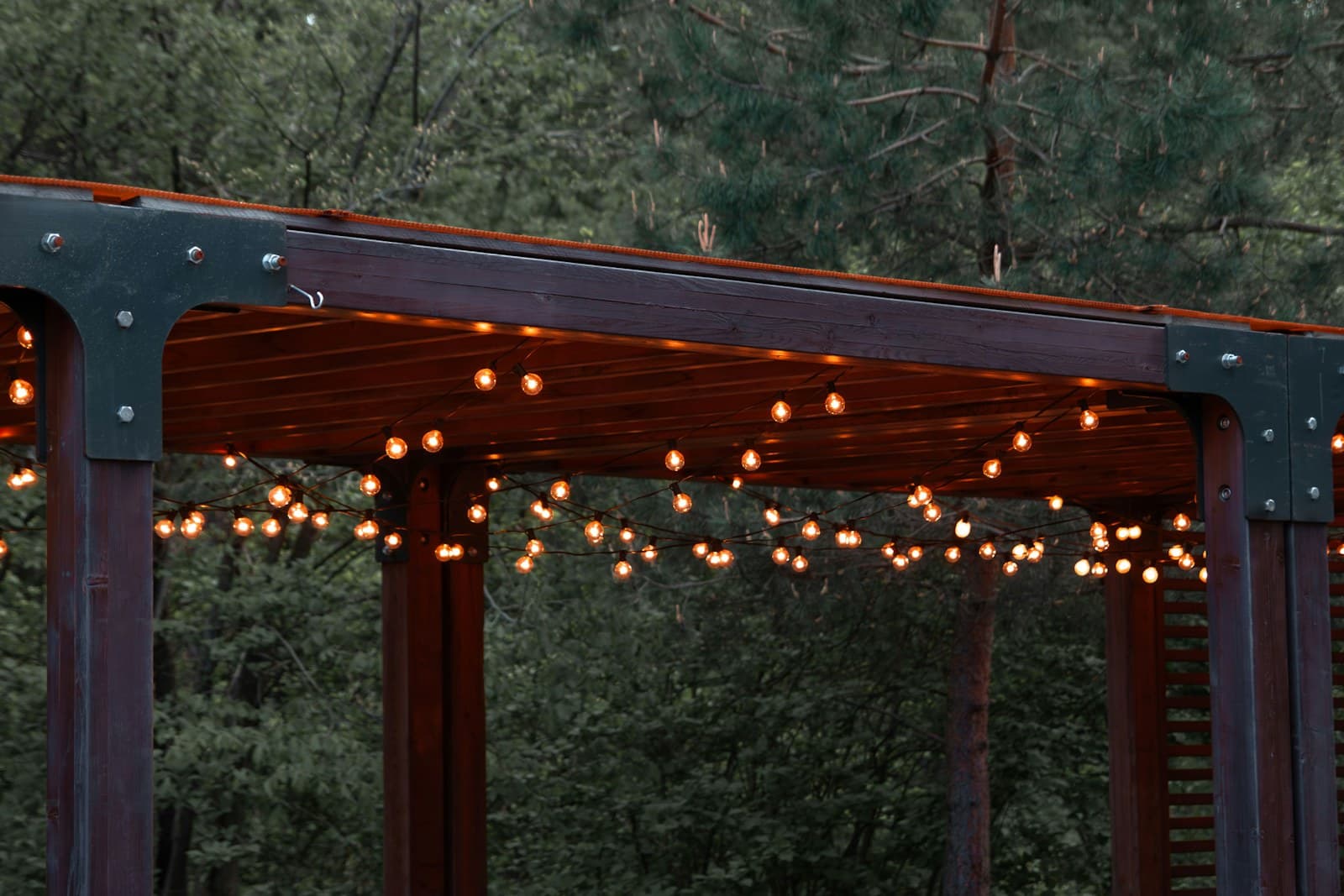
The other half of structural lighting is what most people picture when they think of a beautiful evening on a Placer County patio: warm bistro lights strung overhead on a pergola, a covered loggia, a wood deck, or a fence line. The version we install is permanent, hardwired, and built to last.
We use commercial-grade weatherproof socket strands, not the seasonal strings sold at home centers. The runs are wired to a switch or a smart controller, not daisy-chained to an extension cord. Mounting is done with proper strain relief and weather-rated hardware so the line stays clean and tight through wind and weather. The result is a fixture, not a temporary decoration.
On most projects we install bistro lighting on the primary outdoor living structure, plus accent lighting under the structure for evening use. A pergola with overhead bistro plus low-glow recessed downlights at the seating area becomes a usable room from dusk into the night.
How we approach the design.
Site walk at dusk. We look at the architecture, the outdoor structures, the views, and the way you use the spaces. We propose a layered plan that integrates the facade lighting with any bistro or structural lighting on the outdoor rooms, plus integration with permanent or landscape lighting if those are part of the project.
Color temperature is consistent across the project. Brightness is dialed in onsite. Switches and controllers are placed where they actually make sense to use, usually inside the home next to other living-space switches.
Examples we install often.
On a Whitney Oaks home with a stucco elevation and a stone-clad chimney, architectural lighting might be column uplights, a wash on the stone face, and an accent on the front entry. On a Granite Bay estate with a covered loggia and a pool, it might be facade uplights on the rear elevation, bistro lighting overhead in the loggia, and recessed downlights tied to a single dimmer. On a Loomis property with a wood pergola over a hardscape patio, it might be permanent bistro lighting integrated with downlights mounted at the rafters.
Every project is different. The throughline is that we are designing the architecture as the canvas, not bolting accessories onto it.
What it costs to live with.
Architectural lighting and permanent bistro installs run on tiny amounts of power. Most of our installs add a negligible amount to the monthly utility bill. Maintenance is occasional, usually a single bulb replacement on a multi-year cycle for the bistro strands and effectively zero for the architectural fixtures over the same period. We are a phone call away if anything fails.